TPLO Surgery
TPLO Surgery for Dogs in Chilliwack
For a torn ACL: an in-house knee exam and X-rays, with surgery at our clinic.
Promontory Animal Hospital provides TPLO surgery for dogs in Chilliwack, performed at our clinic by a visiting specialist. First, our own veterinarians examine your dog's knee and take digital X-rays in-house at our Thomas Road clinic to confirm whether the cruciate ligament is torn.
- Thomas Road, Chilliwack
- Open 8:00am to 8:00pm, seven days a week
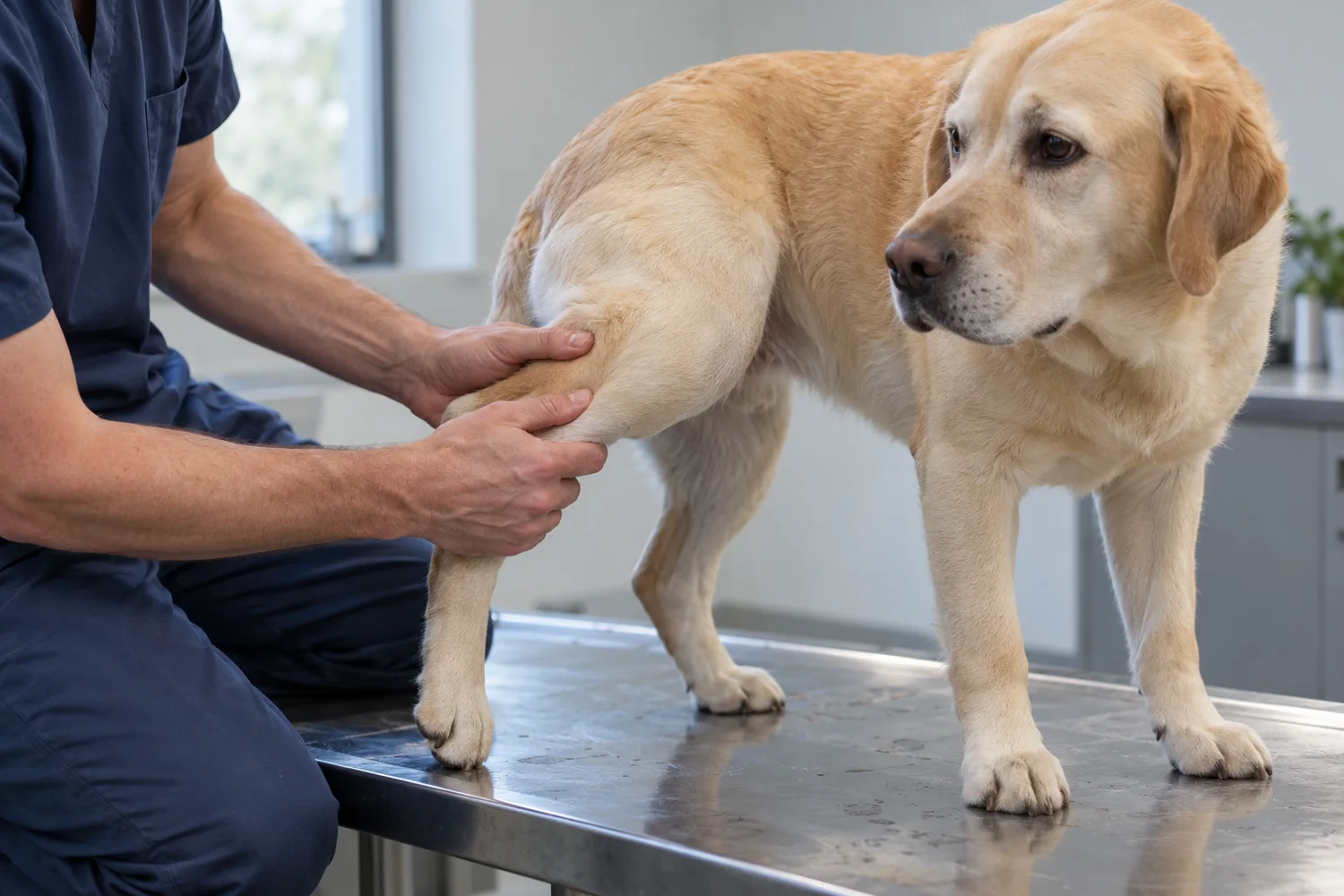
Signs of a torn ACL in dogs
A cruciate problem sometimes shows only as stiffness or a limp when your dog gets up after a long rest. Check the back leg for:
-
A limp on one back leg that starts suddenly or builds up over weeks.
-
Toe touching, where your dog puts only the tip of the paw on the ground.
-
Sitting with the leg out to the side instead of sitting squarely.
-
Trouble rising from a sit or jumping into the car.
-
A thinner thigh muscle on that leg than on the other.
-
A firm swelling on the inside of the shin bone.
A limp that settles with rest still needs an examination. Other causes are covered by our back-leg limping and pain care.
If your dog suddenly cannot bear weight on a back leg, bring them in for urgent care for sudden lameness. We welcome walk-ins for urgent cases, seven days a week. For routine appointments, booking ahead is recommended. We are open 8:00am to 8:00pm, seven days a week.
What is a CCL tear in dogs?
The cruciate ligament keeps the shin bone from sliding forward, and once it fails the knee begins to give way.
The cranial cruciate ligament, which most owners know as the ACL, is the main stabilising ligament in a dog's knee. In most dogs it weakens slowly rather than tearing in one injury, and a partial tear usually becomes a full tear.
40–60%
A torn ligament can also damage the meniscus, a cushion of cartilage inside the knee, which may click as the dog walks. The other knee is at risk too: the American College of Veterinary Surgeons (ACVS) reports that 40 to 60% of dogs with cruciate disease in one knee later develop the same problem in the other, often within the first year or two of diagnosis. The signs above are worth watching for on the other back leg too.
How we examine your dog's knee
A hands-on exam and digital X-rays, both in-house, show whether the knee is unstable and what has changed inside the joint.
- 01
The hands-on knee test
Our veterinarian checks by hand whether the shin bone slides forward against the thigh bone, using the drawer test or the tibial thrust test. A knee that slides points to a damaged cruciate ligament.
- 02
Digital X-ray of the knee
The ligament itself does not show on an X-ray, but the digital X-ray at our clinic can show swelling inside the joint and arthritic changes.
- 03
Pre-anaesthetic bloodwork
If surgery is the next step, we check liver and kidney function before any anaesthetic, so higher-risk dogs are identified in advance.
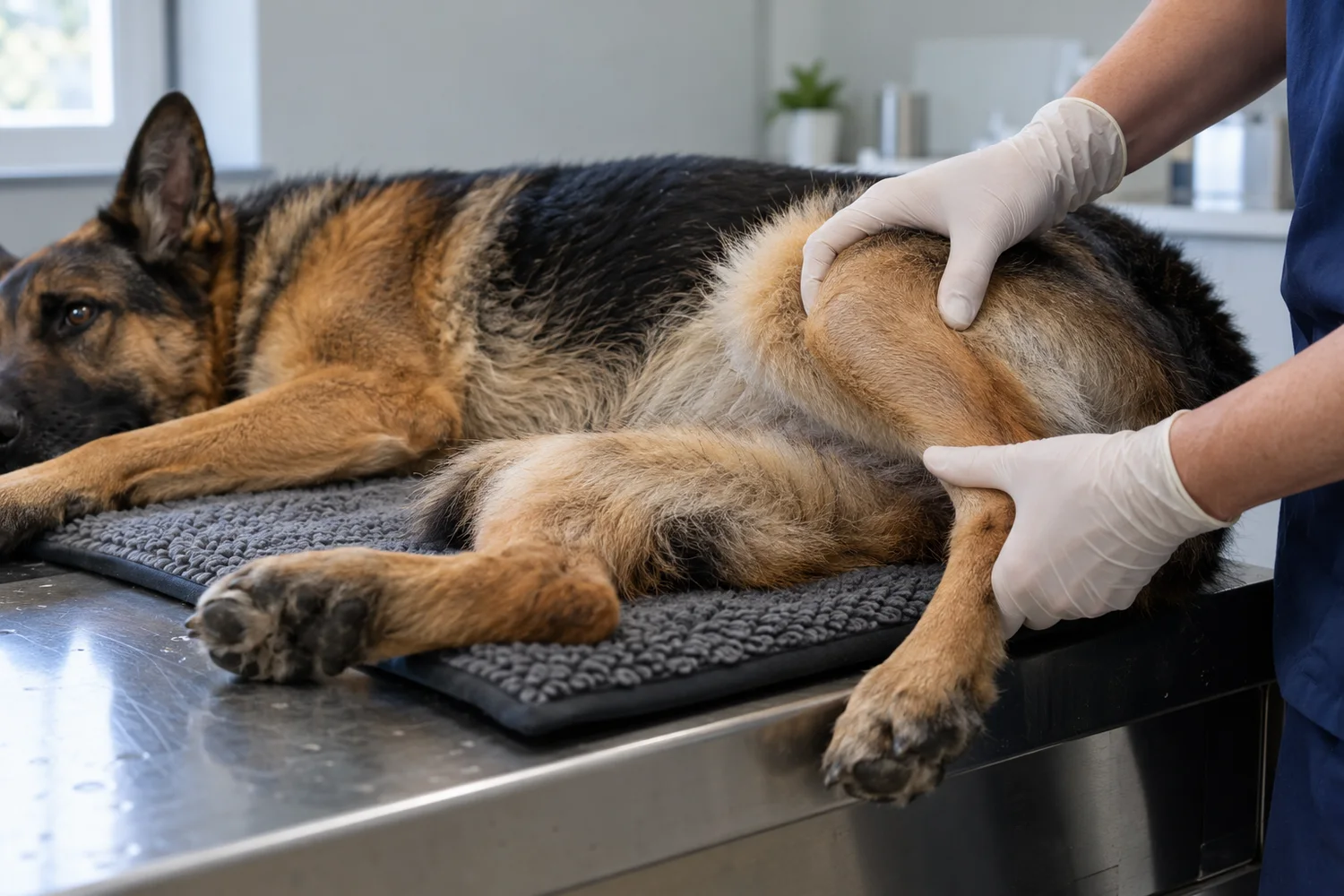
What is TPLO surgery in dogs?
Rather than replacing the torn ligament, TPLO changes the angle of the top of the shin bone so the knee stays stable without it.
Tibial plateau levelling osteotomy (TPLO) is a knee surgery for dogs with a torn cruciate ligament. During TPLO, a curved cut is made in the top of the shin bone, and that section is rotated to level the sloped joint surface. A bone plate and screws hold it in place while the bone heals. The levelled knee stays stable without the torn ligament.
Levelling this slope stops the shin bone sliding forward with each step. The ACVS notes the plate and screws are rarely removed once the bone has healed.
Who does what: our veterinarians and the visiting specialist
Every step, from the first knee exam to the operation itself, takes place at our Thomas Road clinic in Chilliwack.
At our Thomas Road clinic
At Promontory Animal Hospital, TPLO surgery is performed at our clinic by a visiting specialist. Our own veterinarians are the ones you see for the diagnosis and the estimate. Your dog has no trip to a city referral hospital.
To start, request an appointment for a knee exam.
Anaesthesia and equipment
The surgery is done under general anaesthetic, and our veterinary staff monitor oxygen levels, heart rate and blood pressure continuously throughout it. TPLO sits within our surgical services in Chilliwack, and our clinic has advanced equipment for complex soft-tissue and orthopaedic surgery.
TPLO vs TTA and other treatment options
Veterinary surgeons compare these approaches using the knee exam findings, the dog's size and how active the dog is:
| Option | What it does | Usually suited to |
|---|---|---|
| TPLO | What it does Levels the top of the shin bone with a curved cut, plate and screws. | Usually suited to Larger, more athletic dogs. |
| TTA (tibial tuberosity advancement) | What it does Cuts the front of the shin bone and moves it forward, held with a wedge, plate and screws. | Usually suited to Larger, more athletic dogs. |
| Lateral suture (extracapsular repair) | What it does Stabilises the knee after a cranial cruciate ligament (CCL) injury with a strong suture outside the joint. Performed in-house by our own veterinarian. | Usually suited to May not suit larger, younger dogs (ACVS). |
| Conservative management | What it does Strict rest, a gradual return to activity, pain medication and weight control, without surgery. | Usually suited to Mainly small dogs under about 15 kg (33 lb), with limited evidence. |
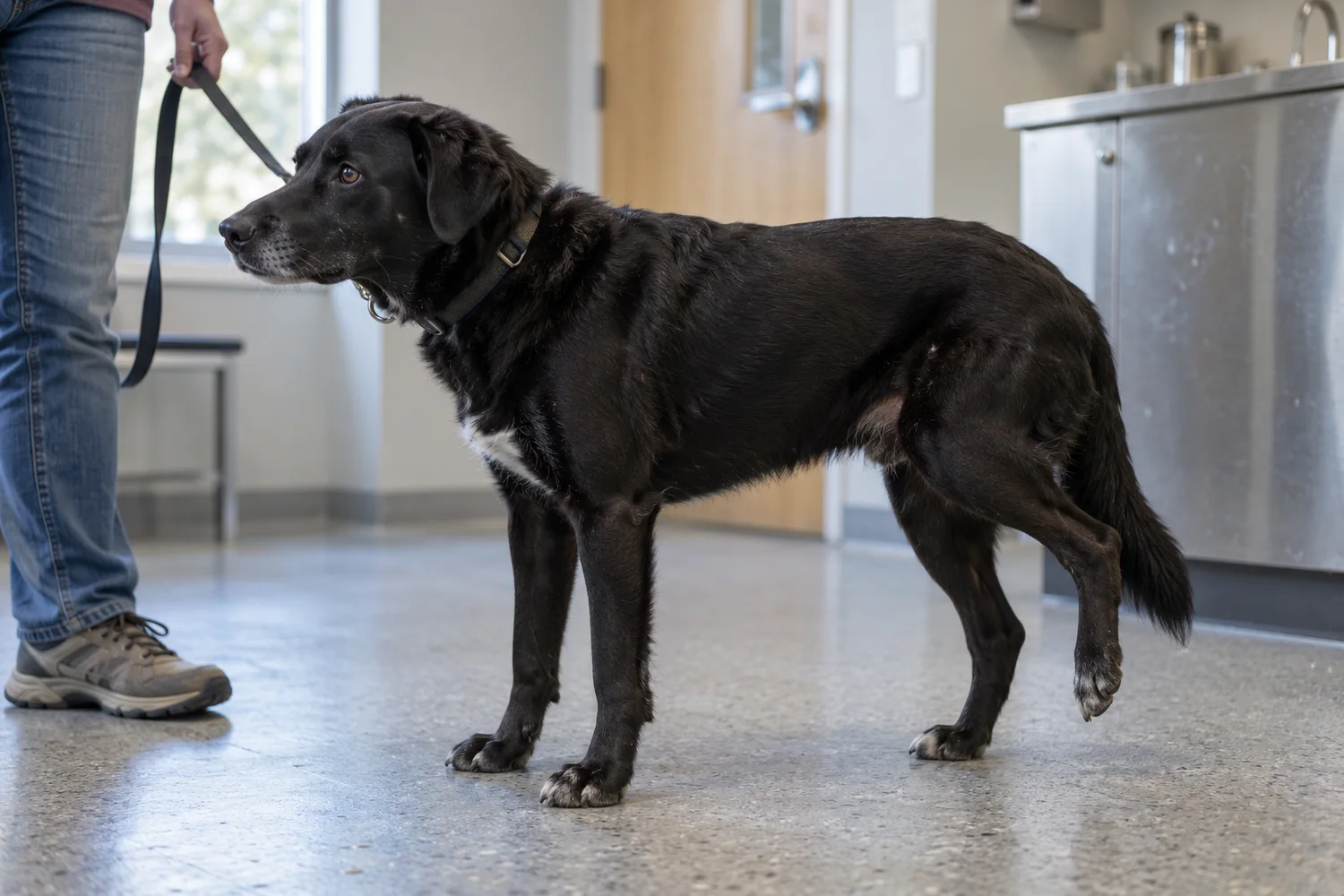
Lateral suture (extracapsular repair)
Lateral suture repair is a surgical procedure used to stabilise the knee following a cranial cruciate ligament (CCL) injury in dogs. This procedure is performed in-house by our own veterinarian, allowing us to provide personalised care, consistent follow-up, and ongoing support throughout your pet's recovery.
Smaller dogs, under about 15 kg (33 lb), have a better chance of doing well with conservative management, the non-surgical alternative to TPLO surgery for dogs, though arthritis still develops. Our veterinarians support those dogs with pain care and weight management for dogs, since less weight means less load on the joint.
TPLO surgery recovery: the first weeks at home
8–12 weeks
The cut bone takes weeks to heal, so activity is restricted while the repair holds.
Recovery after TPLO surgery typically takes 8 to 12 weeks. During the first 6 to 8 weeks, activity should be restricted to short, controlled leash walks, with no running, jumping, or off-leash play. Gradual return to normal activity depends on healing progress and follow-up X-rays. With proper aftercare and rehabilitation, most dogs regain good leg function within approximately 3 months.
We also offer therapeutic laser for recovery after surgery, used for pain management during post-operative recovery.
How much does dog ACL surgery cost?
TPLO cost depends on what the knee exam and X-rays find, and you get a written estimate you approve before any procedure begins.
What shapes the estimate
The estimate reflects your dog's size, what the X-rays show inside the knee, and whether the meniscus needs treatment during surgery.
Payment and financing
We take Visa, Mastercard, American Express, Interac debit and cash. Veterinary financing is arranged through iFinance.
We are accepting new clients at our Thomas Road clinic in Chilliwack, and we serve Sardis, Promontory, Vedder and Yarrow.
- Chilliwack
- Sardis
- Promontory
- Vedder
- Yarrow
Explore more of our services
Pet dental care
Cleanings, dental X-rays and extractions for dogs and cats.
Dog and cat dental cleaningDiagnostics & imaging
Digital X-ray and in-house diagnostics to find what hurts.
Pet X-ray and diagnosticsPet vaccinations
Core and lifestyle vaccines for dogs and cats.
Dog and cat vaccinationsParasite prevention
Protection from fleas, ticks, heartworm and intestinal worms.
Flea, tick and worm preventionQuestions about TPLO surgery
Call 604-426-1057Reviewed by our veterinarians, Dr Gurpreet Kaur, DVM, and Dr Ravinder Singh, DVM.
Is TPLO surgery worth it?
For many dogs, surgery gives the best long-term result. The ACVS describes surgery as typically the best treatment and the only way to permanently control the instability of a torn cruciate, and says most dogs return to an active lifestyle once the bone has healed after TPLO. Arthritis can still progress over the years, though more slowly than without surgery.
What is the TPLO surgery recovery time?
Recovery after TPLO surgery typically takes 8 to 12 weeks. During the first 6 to 8 weeks, activity should be restricted to short, controlled leash walks, with no running, jumping, or off-leash play. With proper aftercare and rehabilitation, most dogs regain good leg function within approximately 3 months.
Can a torn ACL heal without surgery?
The torn ligament does not mend itself. In some dogs, scar tissue builds up over time and steadies the knee, but the ACVS notes the knee stays prone to re-injury and arthritis still develops. Small dogs have the best chance of coping without surgery.
Can a dog knee brace replace surgery?
Not on current evidence. Custom knee braces are a newer option, and the ACVS notes there is little research on how well they work. They can be costly, cause sores or ongoing pain, or not be tolerated. A brace does not repair the torn ligament, so the knee can still give way.
Is TPLO the only dog knee surgery?
No. A torn cruciate can be repaired in several ways, and a 2022 systematic review in Frontiers in Veterinary Science found neither TPLO nor TTA clearly better. Other knee problems need different operations, such as a luxating patella, where the kneecap slips out of its groove. We cover luxating patella and fracture repair separately.
Does pet insurance cover TPLO surgery?
Coverage depends on your policy, so check what it says about cruciate injuries and pre-existing conditions first. We accept pet insurance. We provide the invoices and documentation you need to submit your claim. We work with Trupanion, Petsecure, Fetch and Pets Plus Us.
Is my dog too old for cruciate surgery?
Age is one factor, not the deciding one. The ACVS lists activity, size, age, body build and how unstable the knee is among the factors that shape the best option. Our pre-anaesthetic bloodwork checks overall health, so an older dog is judged on its health rather than its age alone.
Book a knee exam at our Chilliwack clinic
A knee exam with our veterinarians is where TPLO care starts.
What you can count on
- Open 8:00am to 8:00pm, seven days a week
- Knee exams and digital X-rays in-house
- TPLO performed at our clinic by a visiting specialist
- A written estimate you approve before any procedure